


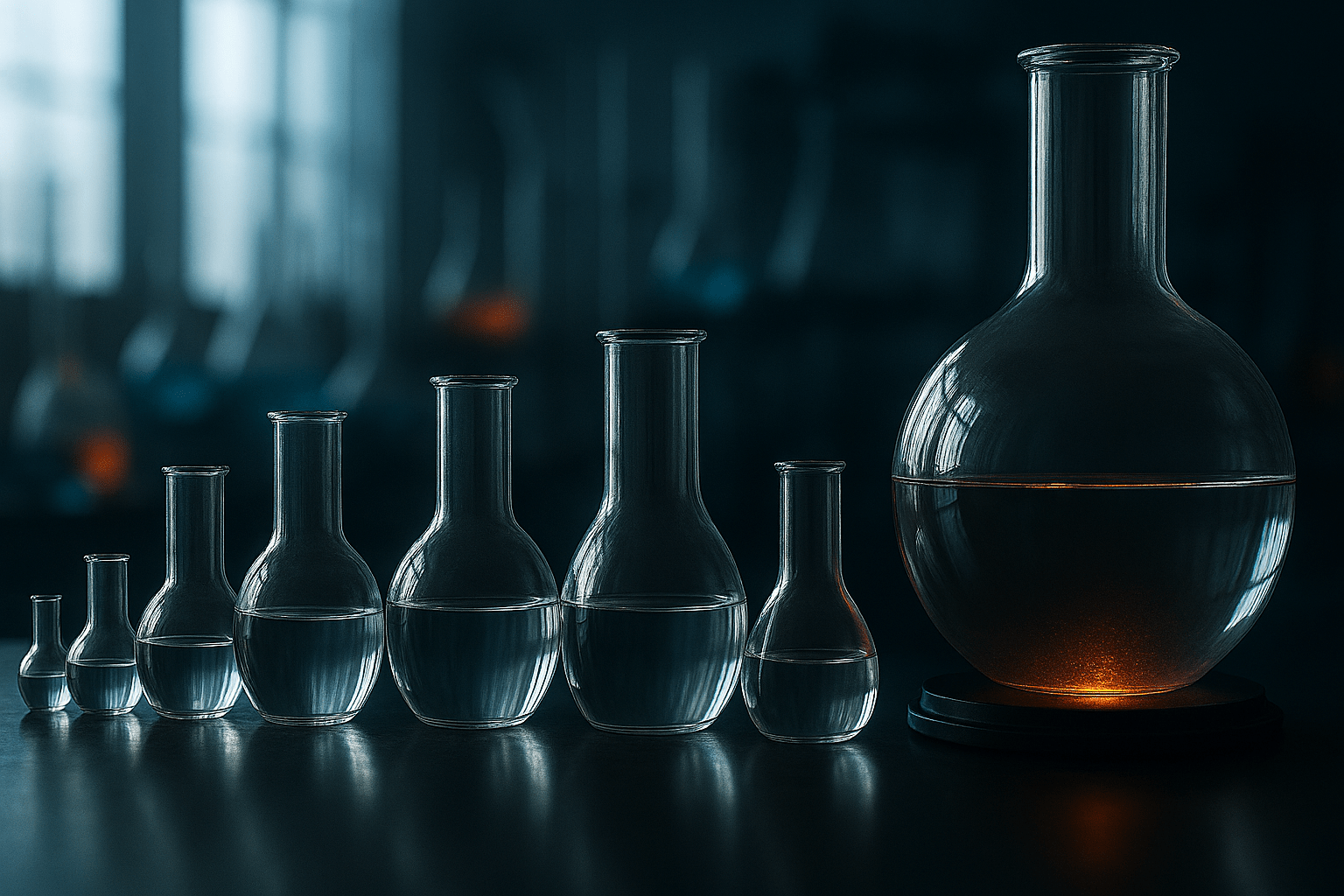
Flat bottom boiling flasks are essential pieces of laboratory glassware used in chemistry, biology, pharmaceuticals, education, and industrial research. Known for their stability and versatility, these flasks are designed to safely heat, mix, and store liquids across a wide range of volumes. Available in sizes from 50 mL to 10,000 mL, flat bottom boiling flasks support everything from microscale experiments to pilot‑scale and industrial processes.
This guide explores common uses for each size and explains why flat bottom boiling flasks are often preferred over round bottom boiling flasks in many laboratory environments.
Why Choose Flat Bottom Boiling Flasks Over Round Bottom Flasks?
While both flat bottom and round bottom boiling flasks are used for heating liquids, flat bottom boiling flasks offer several practical advantages:
- Self‑standing design: Flat bottoms allow the flask to stand upright on benchtops and hot plates without clamps or cork rings.
- Improved stability: Reduced risk of tipping or rolling during heating, stirring, or storage.
- Direct heating compatibility: Ideal for electric hot plates and heating mantles without special supports.
- Convenient storage: Easier to store on shelves compared to round bottom flasks, which require additional supports.
Round bottom flasks excel in specialized applications like uniform heat distribution in reflux systems, but for general laboratory use, flat bottom flasks are often more convenient, economical, and safer for everyday workflows.
Small‑Volume Flat Bottom Boiling Flasks (50 mL and 100 mL)
50mL and 100mL flat bottom boiling flasks are commonly used for:
- Microscale chemical reactions
- Heating small solvent volumes
- Sample preparation and analytical testing
- Teaching and student laboratories
These sizes are ideal for conserving reagents and reducing waste while still allowing controlled heating and observation.
Medium‑Volume Laboratory Flasks (250 mL and 500 mL)
250mL and 500mL boiling flasks are among the most popular sizes in research labs. Typical uses include:
- Bench‑scale synthesis
- Reflux and boiling experiments
- Buffer and solution preparation
- Media preparation in biology labs
Their manageable size and flat base make them excellent for routine heating and magnetic stirring.
Standard Workhorse Size: 1000 mL Flat Bottom Boiling Flasks
The 1000ml 1L flat bottom boiling flask is a staple of laboratory glassware. It is frequently used for:
- Preparing large reagent or buffer batches
- Distillation setups
- Controlled heating of aqueous solutions
- Temporary storage of prepared chemicals
This size balances volume and handling ease, making it suitable for both educational and professional labs.
Large‑Volume Applications (2000 mL and 3000 mL)
2000ml 2L and 3000mL 3 L flat bottom boiling flasks are commonly used for:
- Scale‑up reactions
- Pilot‑scale chemistry and process testing
- Large‑volume dissolution and mixing
- Fermentation and culture experiments (non‑sterile)
The flat bottom enhances stability during prolonged heating or stirring.
Extra‑Large Flat Bottom Boiling Flasks (5000 mL)
5000ml 5L flat bottom boiling flasks are typically used in industrial, environmental, and production‑oriented laboratories. Common applications include:
- Bulk solvent heating
- Large batch extractions
- Stock solution preparation
- Distillation waste collection
Using one large vessel instead of multiple smaller flasks improves consistency and efficiency.
Industrial and Specialized Use: 10000 mL Flat Bottom Boiling Flasks
10000ml 10L flat bottom boiling flasks are designed for specialized scientific and industrial use, such as:
- Process chemistry and scale‑up trials
- Large‑volume distillation and solvent recovery
- Environmental sample processing
- Demonstration and educational display
They are also often repurposed for brew science, engineering tests, and science‑themed installations.
Conclusion
From 50 mL laboratory flasks to 10,000 mL industrial boiling flasks, flat bottom boiling flasks offer unmatched versatility across scientific disciplines. Their stability, ease of heating, and self‑standing design make them a preferred choice over round bottom flasks for many laboratory applications. Selecting the right size and style ensures safer handling, improved efficiency, and better experimental outcomes.

