
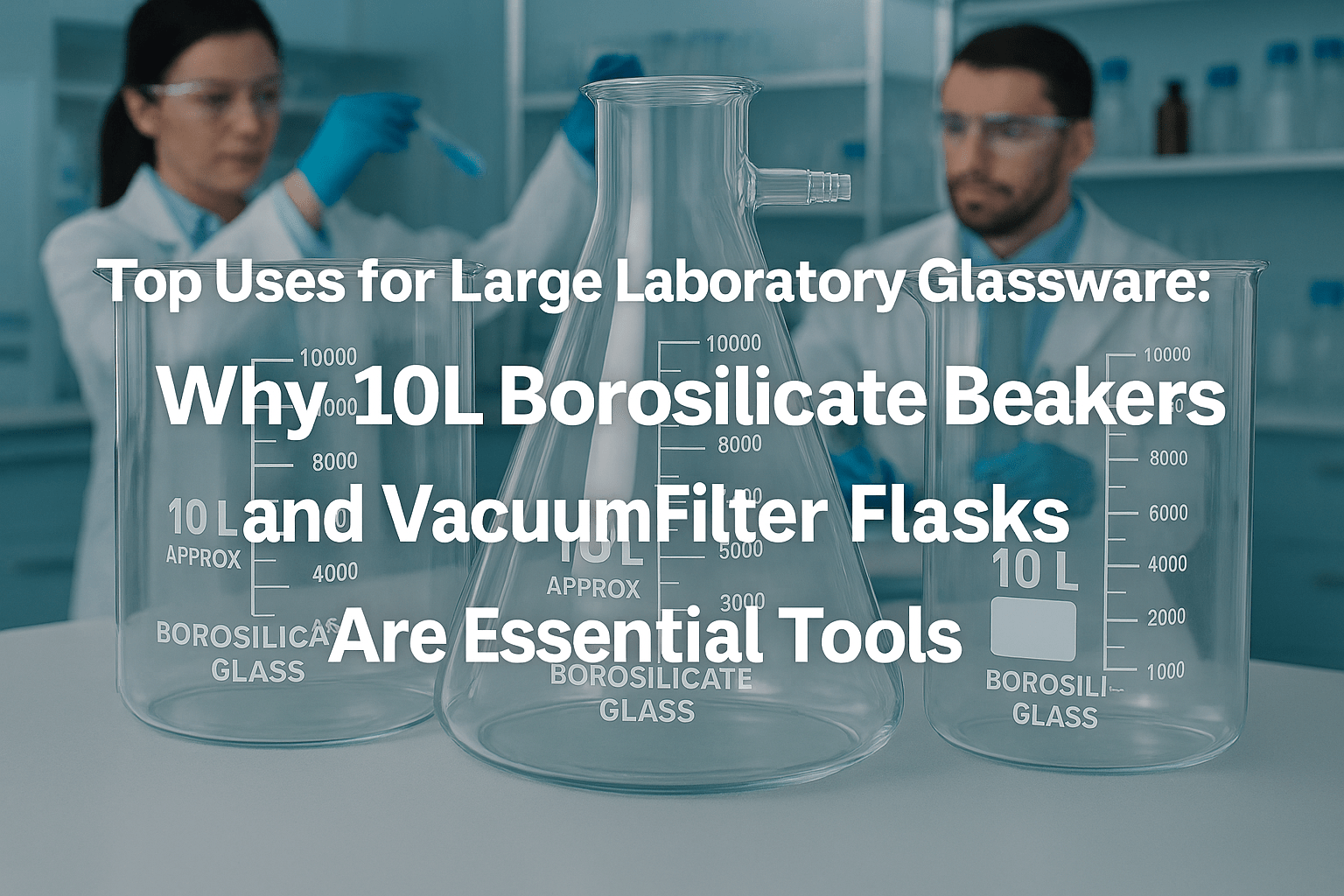
Top Uses for Large Laboratory Glassware: Why 10L Borosilicate Beakers and Vacuum Filter Flasks Are Essential Tools
Large laboratory glassware plays a crucial role in research, industrial processing, environmental testing, and educational demonstrations. While smaller beakers and flasks are standard in most labs, oversized glassware—such as 10L Borosilicate Beakers, 10L Vacuum Filter Flasks, and other high‑capacity vessels—offers capabilities that simply can’t be matched by smaller equipment.
Whether you operate a scientific lab, industrial facility, or educational setting, understanding the uses and advantages of large‑scale glassware can help optimize workflow and improve experimental outcomes. Below, we break down the most common and valuable applications for these oversized tools.
1. Pilot‑Scale Chemical Processing and Large‑Batch Reactions
One of the primary uses for large borosilicate beakers (10L and above) is pilot‑scale chemistry. These bigger vessels provide the volume necessary to test chemical reactions before moving to full production.
Key benefits for chemical processing:
- Ideal for mixing and dissolving bulk chemicals
- Supports reaction scale‑up for pharmaceuticals, polymers, and specialty chemicals
- Handles thermal cycling due to borosilicate’s high heat resistance
- Allows chemists to observe reaction kinetics at semi‑industrial scale
Because borosilicate glass resists temperature shock and chemical corrosion, it remains the preferred material for large‑batch experimentation.
2. High‑Volume Filtration With 10L Vacuum Filter Flasks
When laboratories need to filter large quantities of liquids—especially samples containing debris or particulate matter—a 10L vacuum filter flask becomes indispensable. These oversized flasks pair with vacuum pumps and Büchner funnels to dramatically speed up filtration.
Common filtration uses:
- Processing environmental water samples
- Filtering soil extracts or agricultural runoff
- Clarifying biomass‑rich fluids
- Preparing media and buffers at large volumes
- Removing particulate from industrial wastewater samples
The thick, reinforced sidewalls of a large vacuum flask are engineered to withstand strong negative pressure, making them essential for laboratories dealing with high‑volume or high‑viscosity materials.
3. Food Science and Beverage Research
Food and beverage researchers often rely on large‑capacity glassware to simulate real production conditions. Unlike metal containers, borosilicate glass does not leach flavors or react with ingredients.
Food‑industry applications include:
- Fermentation experiments (beer, kombucha, wine)
- Bulk heating and cooling tests
- Emulsion stability studies
- Extract concentration and reduction
- Pasteurization simulations
Large beakers serve as excellent vessels for observing color changes, clarity, sedimentation, and molecular behavior.
4. Biotechnology and Media Preparation
In biotech facilities, scaling up growth media and preparing sterile solutions requires containers large enough to handle significant liquid volumes.
Oversized glassware is commonly used for:
- Preparing culture media in bulk
- Buffer preparation
- Harvesting and washing biomass
- Filtering media using 10L vacuum flasks
- Maintaining semi-sterile environments through autoclavable glassware
Borosilicate glass is favored in biotechnology because it is non‑reactive, autoclavable, and easy to inspect visually.
5. Educational and Demonstration Uses
Large beakers and flasks are excellent tools for instructors, demonstrators, and science communicators. Their impressive size makes classroom demonstrations easier for audiences to see.
Popular demonstration applications:
- Large‑scale exothermic reactions
- Crystallization and solubility experiments
- Color‑change reactions visible from afar
- Safe audience‑friendly chemistry demonstrations
Because borosilicate glass retains clarity even at high temperatures, it’s reliable for both teaching and presentation environments.
6. General Lab Utility and Everyday Use
Finally, oversized glassware is incredibly versatile. Many labs use their 5–20L vessels for simple, everyday tasks such as:
- Holding or transporting bulk materials
- Creating ice baths
- Preparing cleaning solutions
- Collecting waste
- Washing equipment
Their durability and transparency make them useful far beyond their specialized applications.
Conclusion
Large laboratory glassware—including 10L borosilicate beakers, 10L vacuum filter flasks, and other oversized vessels—plays a vital role across scientific, industrial, academic, and environmental fields. Whether you're scaling up production, filtering large samples, conducting fermentation trials, or teaching a classroom full of students, high‑capacity glassware offers unmatched convenience, safety, and performance.

