
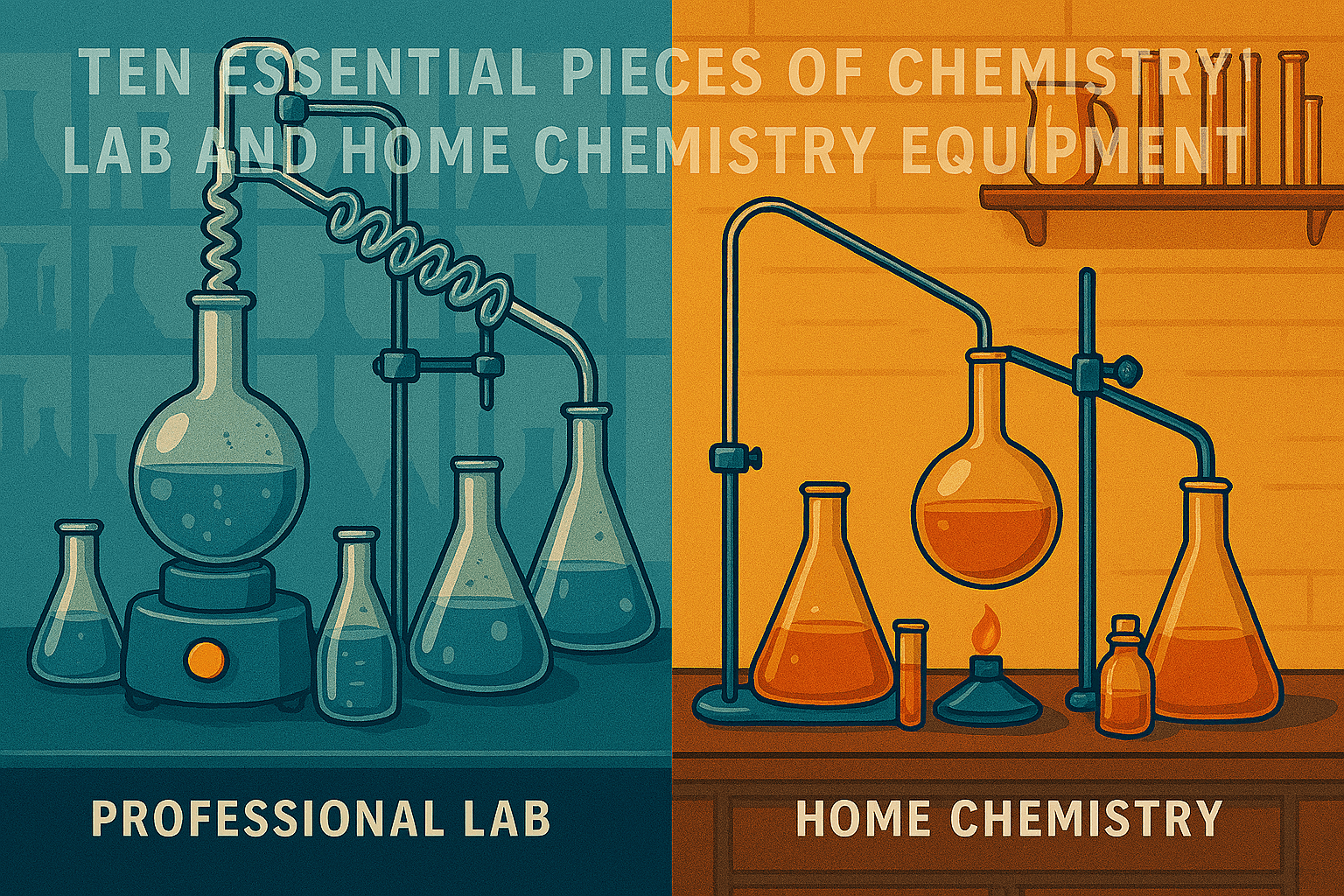
10 Chemistry Lab and Distillation Essentials:
Key Glassware and Tools for Professional and Home Chemistry and Distillation
Outfitting a chemistry workspace—whether a professional laboratory, research environment, or home distillation setup—begins with selecting the right chemistry lab equipment. While distillation plays an important role in organic chemistry and small‑scale botanical extraction, the true foundation of any lab is built on durable, high‑quality laboratory glassware and precision instruments. These essential tools support everything from solution preparation and reaction chemistry to basic purification and measurement tasks.
Below are ten essential pieces of chemistry lab equipment that every lab should have, with emphasis on versatile glassware and core tools used across analytical, organic, educational, and distillation contexts.
1. Laboratory Glassware: Beakers, Flasks, Cylinders, and Pipettes
At the heart of every lab is its laboratory glassware, a category of tools indispensable for mixing, heating, transferring, and measuring chemicals. Borosilicate glass is the industry standard due to its chemical resistance and temperature stability.
Key pieces include:
- Beakers for general mixing and heating
- Erlenmeyer flasks for controlled reactions and swirling
- Round‑bottom flasks for uniform heating and reflux
- Volumetric flasks for precise solution preparation
- Graduated cylinders for accurate measurement
- Pipettes and burettes for fine liquid handling and titrations
These core items are essential for all chemistry work and equally valuable for home lab distillation, where accurate measurement and heat resistance directly affect results.
2. Heating Equipment: Hot Plates, Heating Mantles, and Temperature Baths
Most chemical reactions require well‑controlled heating. Hot plates with magnetic stirrers enable uniform mixing during heating, making them ideal for solution preparation and reaction chemistry. Heating mantles offer safe, even heating for round‑bottom flasks—particularly important in organic synthesis and basic distillation work.
Water baths provide controlled temperature environments for delicate materials or slow, precise heating processes.
3. Condensers and Reflux Equipment
Although distillation is only one aspect of chemistry, condensers are vital tools used across organic and analytical processes. Liebig, Allihn, and Graham condensers aid in reflux, where reactions are heated while vapors continuously cool and return to the flask.
These components are also common in home distillation labs, allowing users to separate vapors efficiently and maintain optimal temperatures.
4. Magnetic Stirrers and Overhead Stirrers
Efficient mixing improves reaction uniformity and reduces reaction time. Magnetic stirrers are ideal for liquids of low to moderate viscosity, while overhead stirrers handle larger volumes or thicker mixtures. These tools are particularly important in research laboratories, formulation labs, and extraction workflows.
5. Analytical and Digital Balances
Accurate measurements are essential in chemistry. An analytical balance capable of measuring to 0.001 g ensures precise formulation, reagent preparation, and quantitative analysis. This level of accuracy is also valuable for essential oil weighing, dilution creation, and botanical extract consistency.
6. Laboratory Thermometers and Digital Temperature Probes
Reliable temperature monitoring is a key factor in maintaining reaction control. Digital thermometers, thermocouples, and glass laboratory thermometers allow chemists to track reaction temperatures and boiling points with accuracy—particularly important for heat‑sensitive materials.
7. Filtration Tools: Funnels, Filter Paper, Vacuum Filtration Systems
Filtration is a universal procedure in chemistry labs. Glass funnels, Buchner funnels, Buchner Funnel Kits and vacuum filtration flasks help separate solids from liquids efficiently. These tools assist with purification, crystallization, and clarifying botanical mixtures before distillation.
8. Drying Racks and Glassware Storage Systems
Clean, dry glassware prevents contamination and ensures accurate experimental results. Glassware drying racks, pegboards, and organized shelving help maintain an efficient workflow while reducing breakage.
9. Ring Stands, Clamps, and Support Hardware
Secure setups are essential when heating or supporting glassware. Ring stands, clamps, bossheads, and three‑finger clamps stabilize condensers, flasks, and funnels during reactions or distillation.
10. Reagent Bottles and Chemical Storage Containers
Proper storage protects chemicals from contamination, degradation, and light exposure. Amber glass bottles, plastic reagent containers, and airtight jars help maintain chemical integrity in both professional labs and home chemistry environments.
Final Thoughts
Whether you're building a professional research facility or a home chemistry workspace, the essential chemistry equipment remains largely the same. Investing in high‑quality laboratory glassware, reliable chemistry lab tools, and precision measurement equipment builds a strong foundation for all types of chemical experimentation—including small‑scale distillation projects.

