
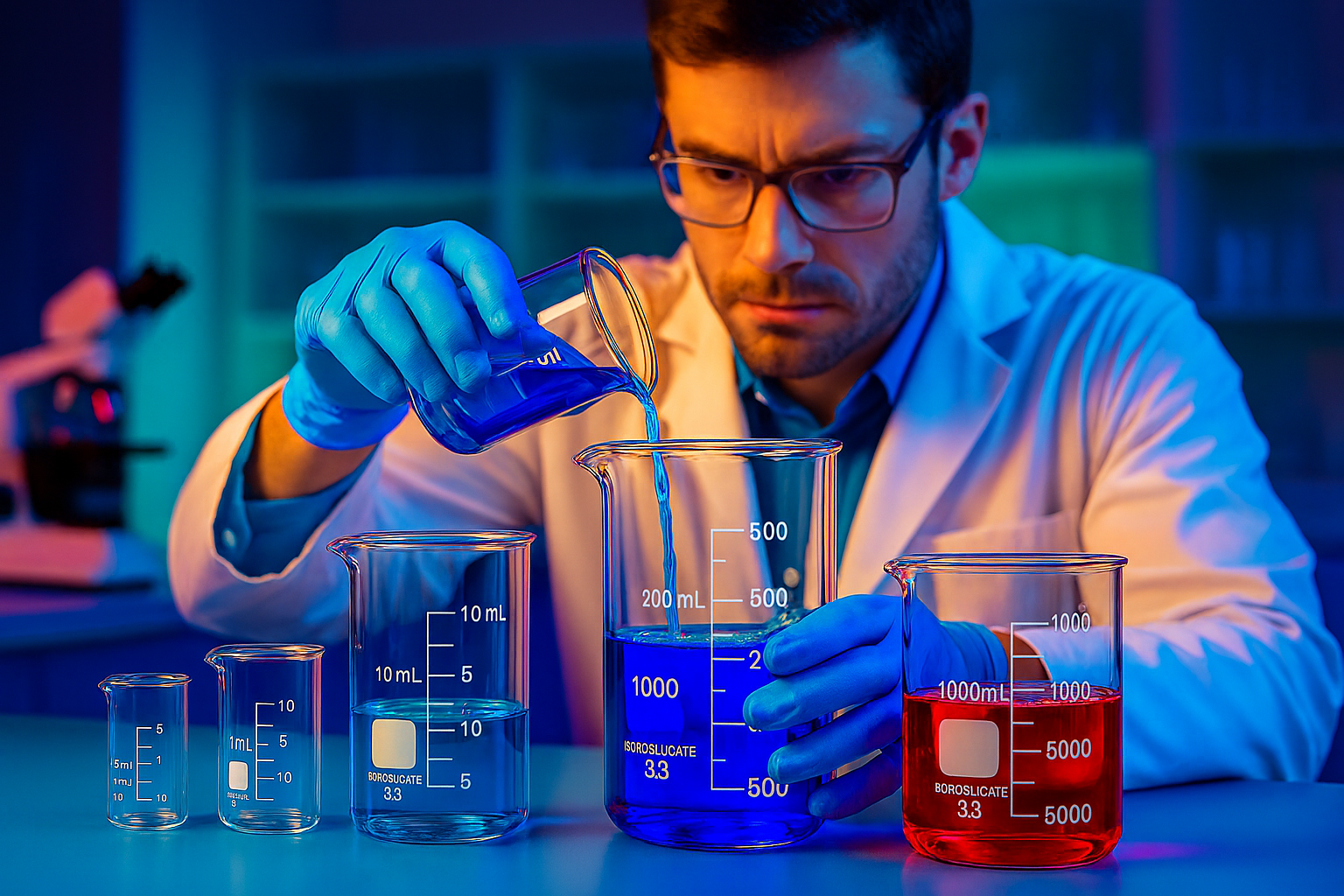
Why Borosilicate Glass Beakers from 5 mL to 10,000 mL Are Essential in Every Laboratory
Borosilicate glass beakers are among the most indispensable pieces of laboratory equipment, relied on by researchers, chemists, educators, and hobby scientists alike. Durable, heat‑resistant, and chemically stable, these borosilicate glass beakers serve as the backbone of countless chemistry experiments and scientific applications. A lab equipped with a full range of beaker sizes from 5 mL to 10,000 mL gains flexibility, precision, and the ability to work at any scale.
Why Borosilicate Glass Is the Standard for Lab Glassware
One of the main reasons borosilicate glass is preferred in science laboratories is its exceptional ability to withstand thermal shock. The material’s low thermal expansion allows beakers to move from heating to cooling environments without cracking, making them ideal for hot plates, autoclaves, and ice baths. These qualities also make borosilicate beakers resistant to chemical corrosion, allowing contact with acids, bases, solvents, and reagents used across chemistry and biology labs.
Because of this durability, borosilicate beakers remain reliable over years of repeated use—something essential in educational labs, research facilities, and industrial environments.
The Importance of Small Beakers: 5 mL to 50 mL
Small‑volume beakers are vital for precision‑focused scientific work. In micro‑scale chemistry, analytical testing, or experiments involving limited reagents, beakers in the 5 mL, 10 mL, 25 mL, and 50 mL range are indispensable.
Small borosilicate beakers are ideal for:
- Micro‑reactions and small‑volume chemical tests
- Handling valuable or rare chemicals
- Evaporating tiny solvent quantities
- Preparing micro‑solutions
- Observing precise reaction changes
Because borosilicate glass is exceptionally clear, scientists can easily monitor color shifts, precipitation, and reaction behavior—even at very low volumes. These small beakers support accuracy and reduce chemical waste.
The Workhorse Beakers: 100 mL to 1,000 mL
Mid‑sized beakers—especially 100 mL, 250 mL, 400mL, 500 mL, 600mL and 1,000 mL—are the most commonly used beakers in any laboratory. These sizes are perfect for routine chemistry experiments, educational demonstrations, and general scientific procedures.
Common uses include:
- Preparing reagents and buffer solutions
- Mixing chemicals for daily lab work
- Heating samples on hot plates
- Performing titrations and dilutions
- Catching filtrate during filtration
Their versatility makes them essential in school labs, research centers, and industrial testing facilities. These are the sizes most scientists reach for on a daily basis.
Large‑Capacity Beakers: 2,000 mL to 10,000 mL
Large beakers are just as important, especially in research, production labs, environmental testing, and classroom demonstrations. Beakers in the 2,000 mL, 3,000mL, 5,000 mL, and 10,000 mL range allow scientists to work with larger batches and store or mix high‑volume solutions.
Large borosilicate glass beakers are ideal for:
- Preparing bulk chemical solutions
- Holding large filtrate volumes
- Cleaning or soaking equipment
- Conducting large‑scale reactions
- Demonstrating experiments to groups
The strength and heat resistance of borosilicate glass become even more critical at this scale.
Why Every Lab Needs a Full Range of Beaker Sizes
Having a complete set of borosilicate glass beakers from 5 mL to 10,000 mL ensures readiness for any experiment. Small beakers support precision work, mid‑range beakers handle daily laboratory tasks, and large beakers make bulk preparation and demonstrations simple.
A lab missing key sizes limits efficiency—and sometimes even limits what experiments can be performed.
Whether you're outfitting a professional research facility, a school science lab, or a personal chemistry workspace, a full range of borosilicate beakers ensures accuracy, flexibility, and long‑term durability.

