
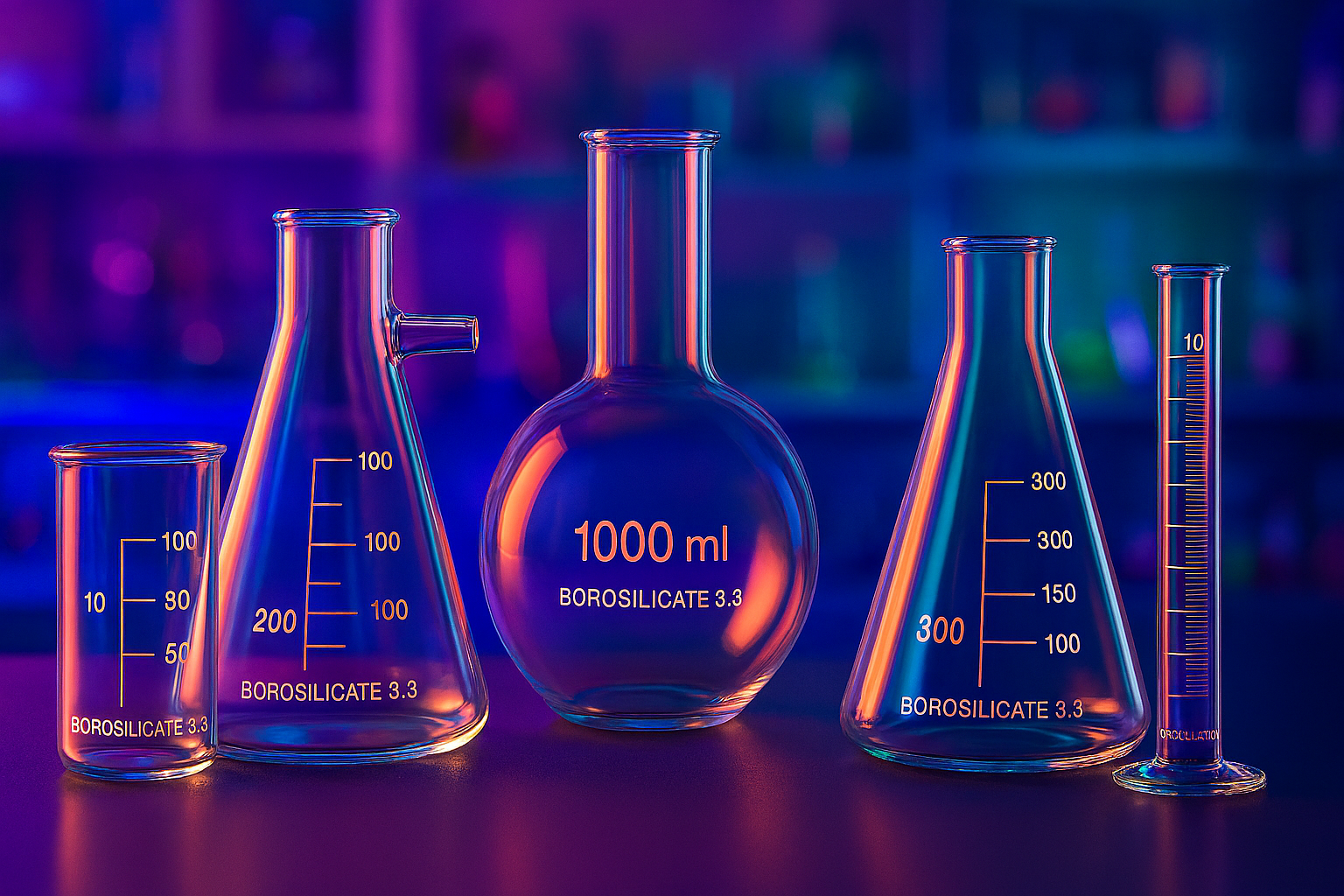
Why Borosilicate Glass 3.3 Laboratory Glassware Is the Superior Choice for Beakers, Flasks, and Measuring Instruments
In any modern laboratory, the quality of your tools directly affects the reliability of your work. Among all available materials, Borosilicate Glass 3.3 consistently ranks as the gold standard for laboratory glassware, including borosilicate beakers, Erlenmeyer flasks, vacuum filter flasks, flat bottom boiling flasks, graduated measuring cylinders, and volumetric flasks. Its performance, durability, and precision make it the ideal choice for professional scientific settings where accuracy and reliability matter.
Below, we explore why Borosilicate Glass 3.3 remains unmatched and why it is widely recognized as the best glassware for lab use.
Exceptional Thermal Resistance
A defining feature of Borosilicate Glass 3.3 is its extremely low coefficient of thermal expansion, making it exceptionally heat‑resistant laboratory glassware. Scientists can heat, cool, or transfer liquids rapidly without worrying about cracking or structural failure.
This makes borosilicate ideal for:
-
Flat Bottom Boiling Flasks
Perfect for uniform heating in chemistry labs, where direct flame or hot plate exposure requires high‑quality scientific glassware. -
Borosilicate Beakers and Erlenmeyer Flasks
Everyday tasks such as dissolving solids or heating solutions demand durable borosilicate laboratory glass that will not warp or shatter.
For applications involving extreme temperature changes, borosilicate vs plastic labware isn’t even a competition; plastic deforms, while borosilicate thrives.
Outstanding Chemical Durability
Laboratories frequently work with corrosive, reactive, and solvent‑based chemicals. Chemical‑resistant lab glass is essential — and Borosilicate Glass 3.3 excels here as well.
It stands up to:
- Strong acids
- Organic solvents
- Aqueous solutions
- Mild bases
This resistance is especially important for:
-
Vacuum Filter Flasks
These vessels must withstand strong vacuum pressure and exposure to aggressive solvents during filtration. -
Volumetric Flasks
Purity and accuracy are essential when preparing analytical solutions. -
Graduated Measuring Cylinders
Long‑term exposure to various chemicals won’t damage the etched calibrations or compromise accuracy.
When purity matters, nothing matches the inert nature of borosilicate laboratory glassware.
Precision and Measurement Accuracy
Nearly every scientific process depends on accurate measurements. Borosilicate’s stability and clarity make it ideal for precision laboratory instruments, ensuring consistent performance.
Volumetric Flasks
Designed to measure extremely precise volumes, their calibration remains reliable thanks to borosilicate’s dimensional stability.
Graduated Measuring Cylinders
Clear, chemically etched markings ensure reliable volume readings even after hundreds of uses.
Beakers and Erlenmeyer Flasks
While less precise than volumetric vessels, they still offer dependable, easy‑to‑read gradations, making them essential scientific measuring equipment.
Borosilicate’s precision is a critical reason it dominates professional and academic laboratories.
Mechanical Strength and Superior Durability
Despite its glassy appearance, Borosilicate Glass 3.3 offers impressive mechanical strength. It resists scratches, impact, and vacuum pressure better than standard glass.
This strength benefits:
- Vacuum Filter Flasks, which must withstand negative pressure
- Boiling Flasks, which require structural integrity despite thermal stress
- Everyday glassware that gets moved, washed, and reused frequently
Its long lifespan makes borosilicate one of the most cost‑effective lab equipment materials available today.
Clarity and Transparency
Crystal clarity is an essential but often overlooked benefit. With high‑quality borosilicate lab glass, researchers can clearly observe:
- Reaction progression
- Color changes
- Precipitate formation
- Phase separations
This optical clarity supports better decision‑making, safer chemistry, and more reliable results.
Compatibility With Sterilization
Another major advantage is borosilicate’s compatibility with:
- Autoclaves
- High‑temperature ovens
- Chemical disinfectants
- Repeated washing cycles
Plastic labware warps or degrades under these conditions, while borosilicate glass 3.3 remains stable and sterile — exactly what you want for professional lab flasks and beakers.
Environmentally Responsible and Cost‑Effective
Because Borosilicate Glass 3.3 lasts for years and is 100% recyclable, it supports sustainable laboratory practices better than disposable plastics. While the initial investment is higher, the long‑term value is unmatched.
Conclusion
For every application — heating, cooling, measuring, filtering, mixing, or observing — Borosilicate Glass 3.3 outperforms other materials. Its unmatched combination of thermal resistance, chemical durability, precision, clarity, and longevity makes it the superior choice for borosilicate beakers, Erlenmeyer flasks, vacuum filter flasks, volumetric flasks, graduated cylinders, and all forms of professional lab equipment.
When accuracy and reliability are non‑negotiable, borosilicate isn’t just an option — it’s the standard!

